
Summary of work carried out
External cable, earthing system installation at a fast food restaurant
- Earthing installation — installation and connection of earth electrodes
- New technical solution — developed on site
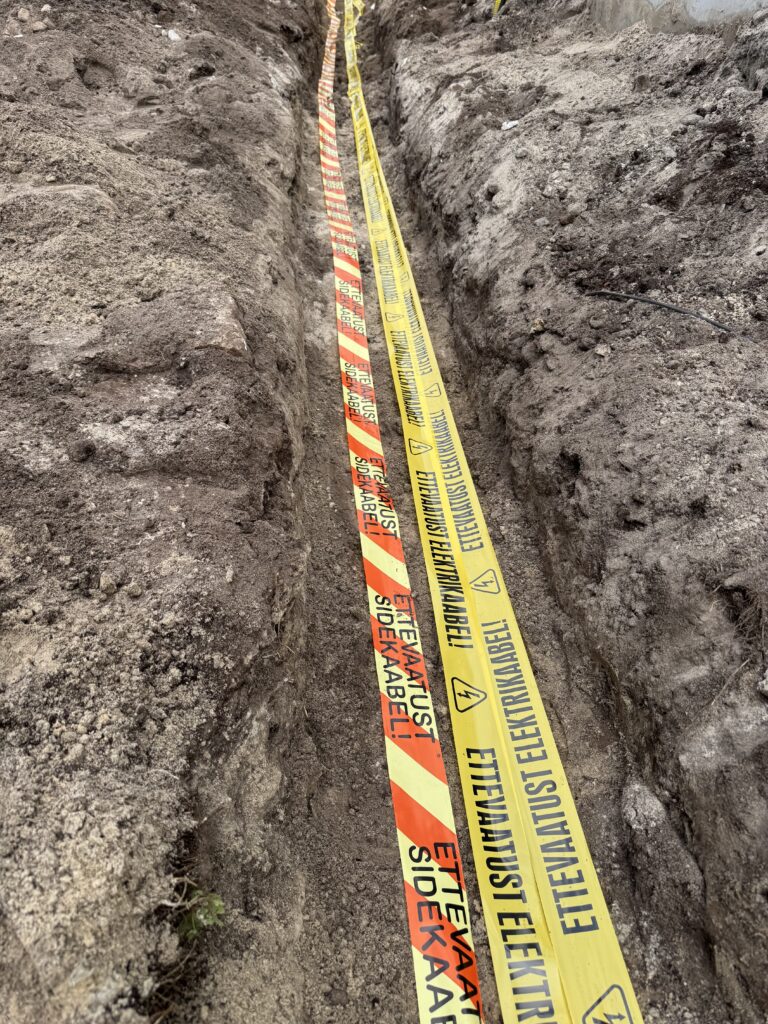
- Cabling — external cable route installation
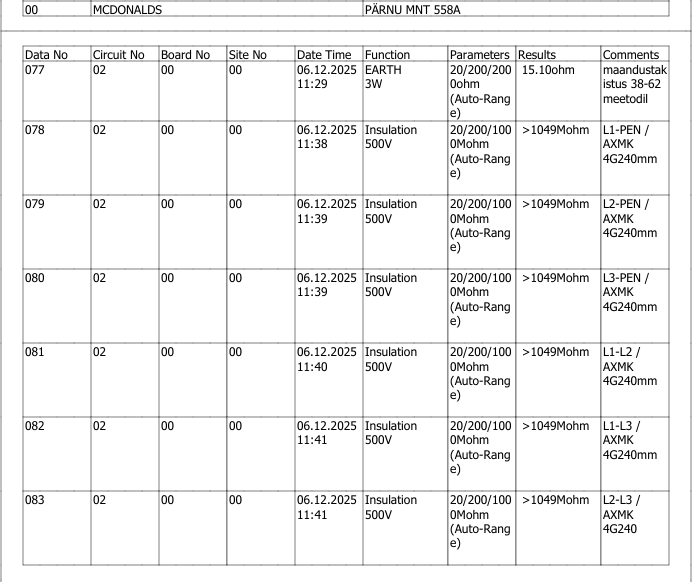
- Test reports — testing and documenting the results
- Handover records — preparing and handing over the documentation
Earthing system
The ground is a mix of gravel, sand and limestone, with an expected resistivity in the range of 500–1500 Ω·m. From an earthing point of view this is difficult ground — the same arrangement gives a resistance several times higher here than it would in clay.
The originally planned solution would have required a long buried steel conductor. Technically sound, but unreasonably expensive given the volume of excavation involved. We worked through an alternative and proposed a combination: 40 m of RD10 round conductor at a depth of 0.7–1 m, combined with earth rods driven beneath the building.
Calculated result: 16.1 Ω at a soil resistivity of 500 Ω·m and 48.4 Ω at 1500 Ω·m. The building is not required to have a lightning protection system, so this level meets the requirements.
New technical solution
Combining a horizontal earth conductor with rods delivers three advantages at once.
- Less excavation — half the trench length, the same result
- ring earth electrode arrangement — the conductor runs around the building in both directions, so a single failed connection does not cause a complete break
- More stable result — the rods reach deeper, where soil moisture, and therefore resistivity, varies less seasonally
In variable ground this combination is more dependable than either arrangement on its own — and it stays stable for decades.
Documentation
The works concluded with testing and the handover of documentation: test reports and handover records.