
Summary of work carried out
Bringing an old electrical installation up to standard — from risk assessment to audit
- Site inspection and risk assessment
- Verification testing of the existing installation
- Schedule of defects and recommended remedial actions
- Certificate of remedial works
- Quote based on the test results
- Design
- Earth electrode installation
- On-site installation work
- Thermal imaging inspection
- Verification testing after completion
- Auditing
The job started with a thorough inspection, not with a quote
It became clear on site that no quote could be given without reviewing the entire system as a whole. With an old installation you cannot price the work superficially — until it has been inspected, nobody knows how much work actually lies ahead.
So we started with verification testing and a risk assessment:
- Continuity testing of protective conductors (PE)
- Resistance measurement of protective and equipotential bonding conductors
- Insulation resistance measurement
- Earth fault loop impedance measurement
- RCD trip testing; where no RCDs were fitted, verification testing of protective device operation
- Earth electrode resistance measurement
For the remedial proposals, a certificate of remedial works — a document stating specifically what needs to be done for the installation to comply. Only on that basis did we prepare the quote.
What the testing revealed
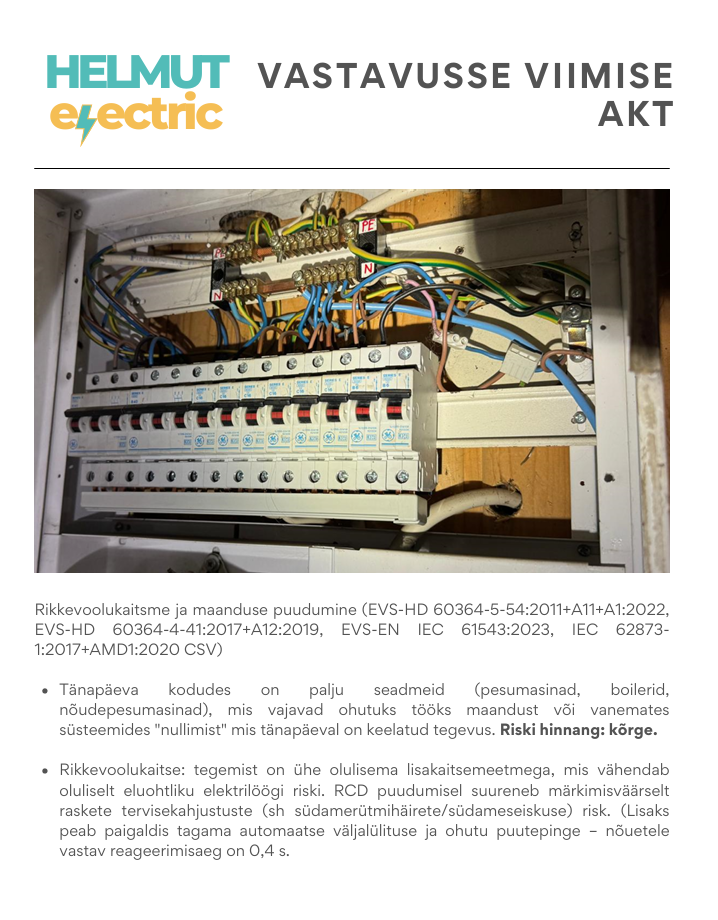
- The earthing system was missing entirely — protective conductors and metal enclosures were essentially floating, there was no earth electrode, which meant earth resistance could not even be measured
- No PEN link was fitted — the protective and equipotential bonding conductor circuit was broken and left floating
- No RCDs were installed
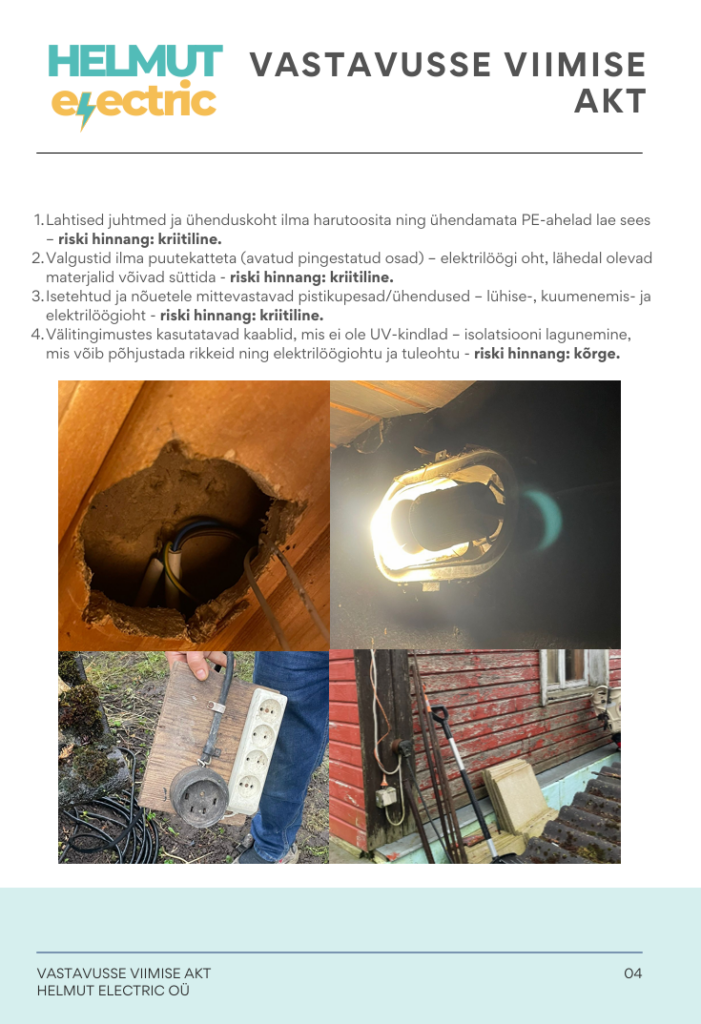
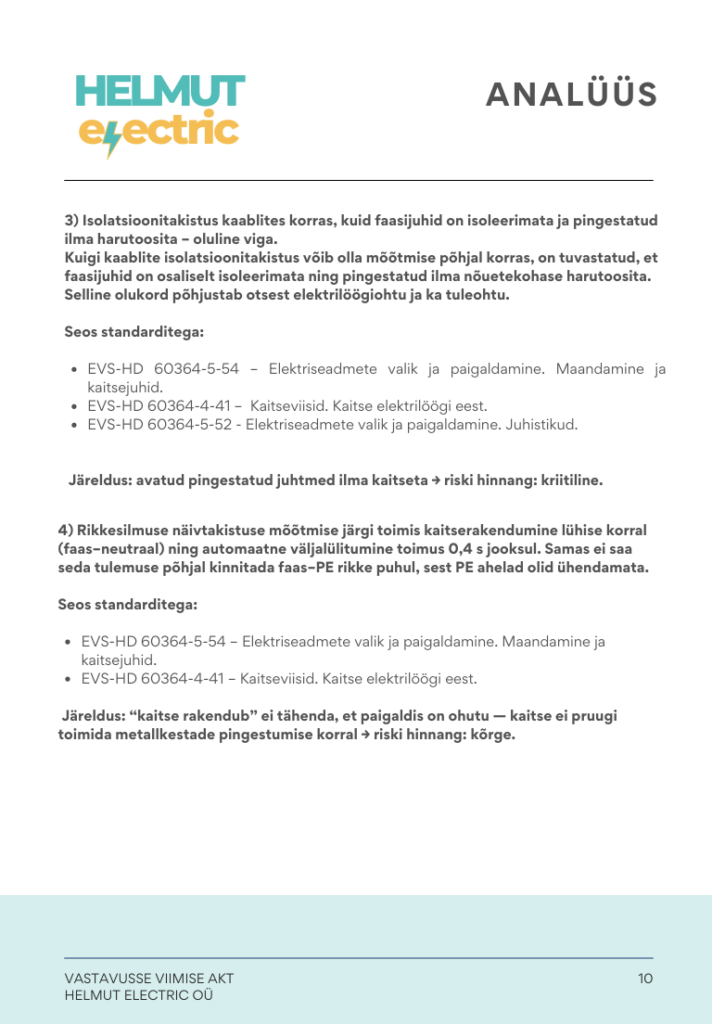
- In the event of a line-to-PE fault, operation of the protective device could not be confirmed, as the PE circuits were not connected; on a line-to-neutral short circuit, the device operated within the required 0.4 seconds
- Insulation resistance in the cables was satisfactory, but uninsulated live conductors were found without proper junction boxes
The problem areas were rated on a four-level scale: critical (immediate risk of electric shock or fire), high (protective device may fail to operate), medium (deviation from the standard, but low direct risk) and low (documentation or minor defect).
This way the owner knows what has to be dealt with immediately and what can wait until the next phase — instead of receiving a list where everything is equally "needs doing".
The solution
- Design — the solution was based on test results, not assumptions
- Earthing installation — construction of the missing earthing system
- On-site installation work — clearing the defects in the order listed in the schedule
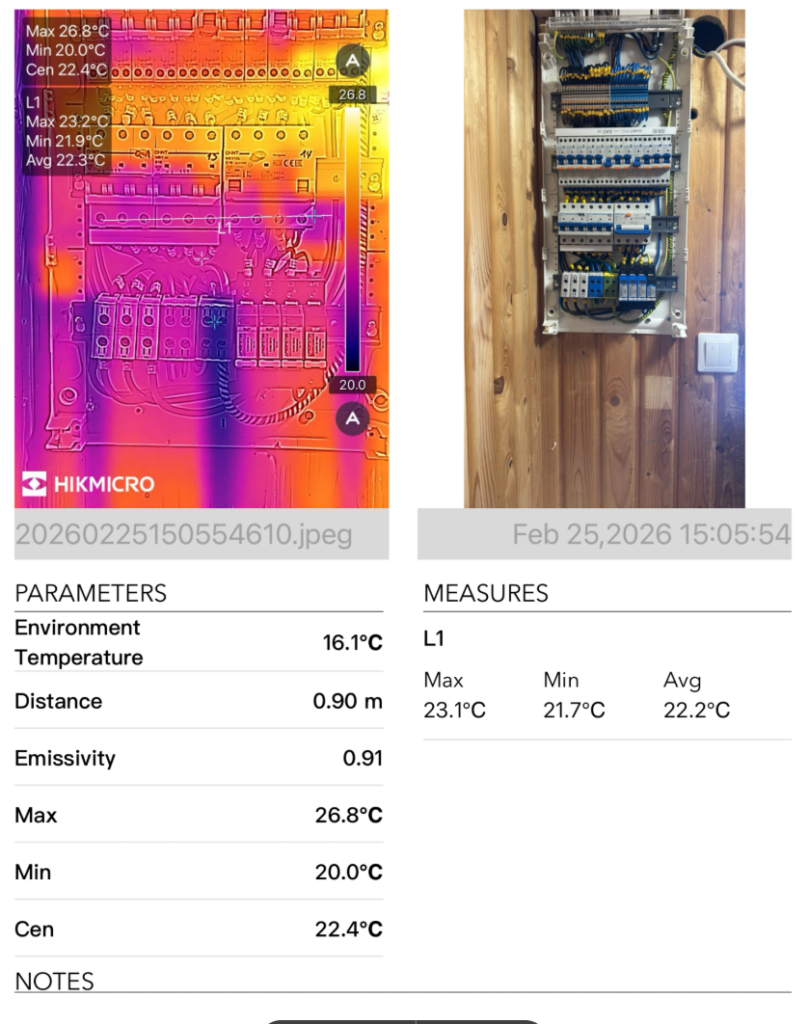
- Thermal imaging inspection — to detect heating of connections under load
- Verification testing — the same tests repeated, to prove the result
- Audit — confirming that the installation complies
The owner received complete documentation: test records from before and after, the schedule of defects, as-built documentation and the audit result. If anyone asks later what condition the installation is in, the answer is there on paper.
Why we work this way
With an old installation, a quick quote is the most expensive option there is. Either the price is too high because unknown risk has been priced into it, or it is too low, and then extra work nobody saw coming turns up mid-job.
Testing before quoting costs little and gives both sides certainty: the owner knows what they are paying for, and we know what we are promising. Without measurements, safety is an opinion, not knowledge.