Summary
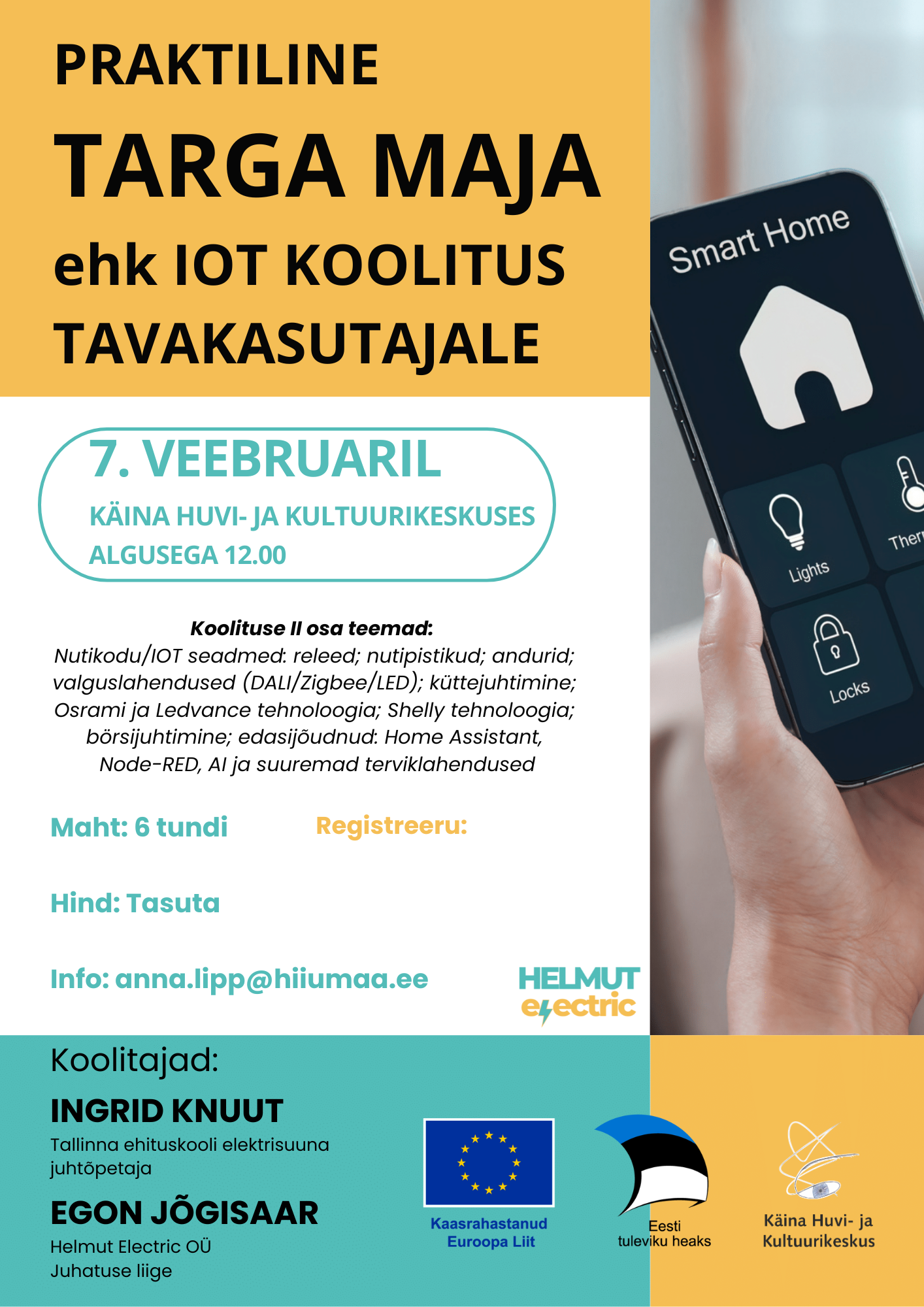
A two-part course: "The practical smart home — an IoT course for the everyday user"
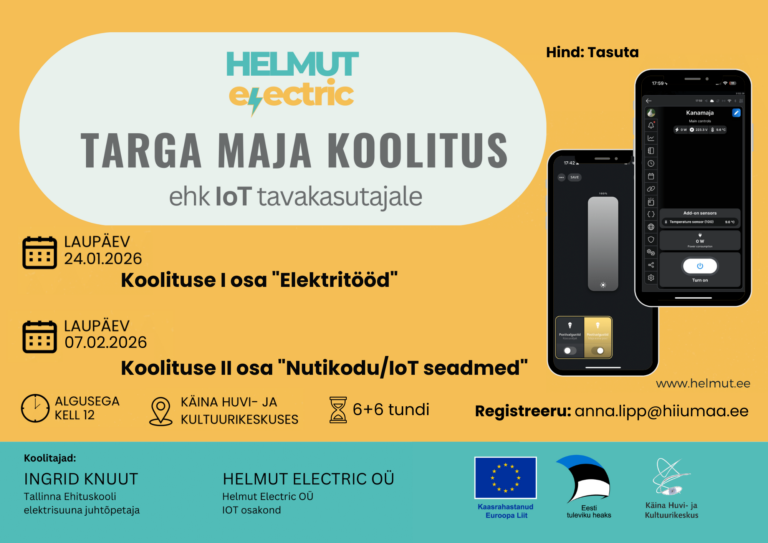
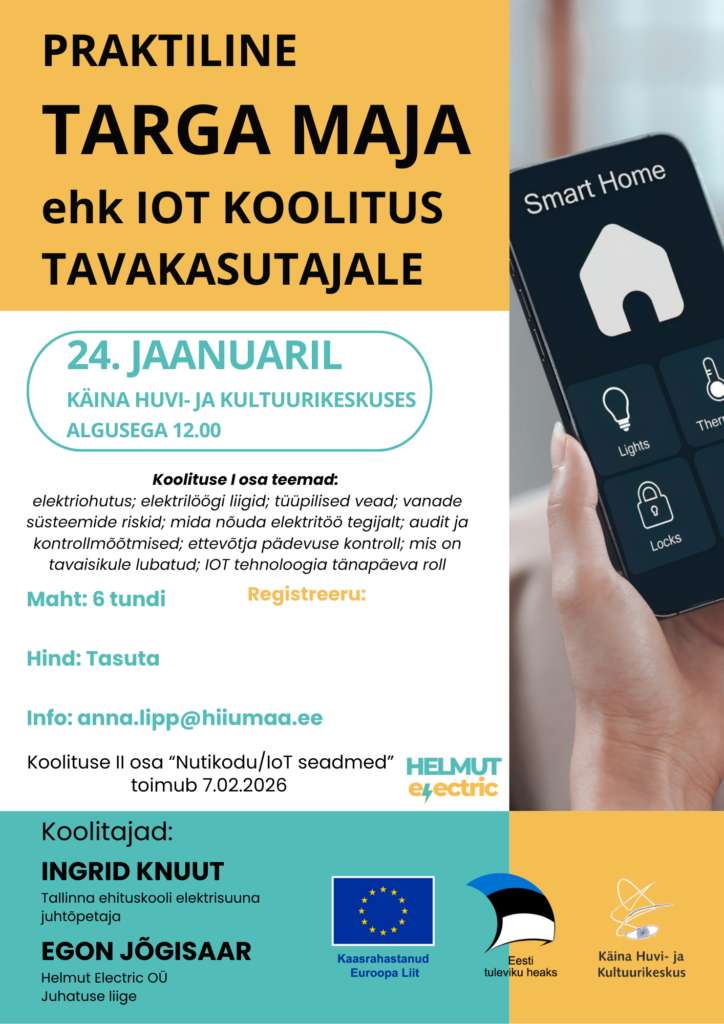
The course was held at the Käina Culture and Leisure Centre in two parts — Part I on 24 January, Part II on 7 February. Six hours each, free of charge for participants. Co-funded by the European Union.
Instructors — Ingrid Knuut, lead teacher of the electrical department at Tallinn Construction School, and Egon Jõgisaar, board member of Helmut Electric OÜ.
Aim
To give the everyday user — a homeowner, an apartment association member, a business owner — the ability to assess their own electrical installation critically. To know what to require from whoever carries out electrical work, how to check a contractor's qualifications, and when an installation should not be used at all. And on the second day: what smart home technology actually delivers, and what it does not.
Part I — electrical safety and legislation
- Types of electric shock and risk factors — direct and indirect contact, the effect of current on the human body
- Common installation faults and their consequences
- Risks in older installations — service connection boards, aluminium wiring, PEN separation, oversized protective devices
- What to require from whoever carries out the work — declaration of conformity, schematic diagrams, test report
- Inspection and testing — what is measured, and what the results mean
- Checking a contractor's qualifications in the TARVIK register
- What electrical work a layperson is permitted to do, and what they are not
Part II — smart home and IoT devices
- Relays, smart plugs and sensors
- Lighting solutions — DALI, Zigbee, LED
- Heating control and control based on exchange prices
- Osram, Ledvance and Shelly technology
- For the more advanced: Home Assistant, Node-RED, AI and larger integrated systems
Why we do this
Most dangerous electrical installations are not dangerous because the owner was careless — they are dangerous because nobody ever told them what to ask and what to look at. The course material comes from our own sites: photographs from damage assessments, test reports, real faults in real boards. Not theoretical examples.
The same principle applied on the second day: smart home technology was presented together with its limitations — what runs locally, what depends on the cloud, and what stops working when the manufacturer leaves the market.